Thursday, 19 July 2012

The Tweedmouth Salmon Queen

The main event to report this week is the crowning of the Tweedmouth Salmon Queen this evening. In the foreground of the picture is the boat in which the Queen and her attendants arrived, a type of boat traditionally used for salmon fishing known as a coble. For this event the boat is mounted on wheels and pulled by a van. On the stage set up in the public gardens on the river bank the new Queen waits to be crowned and her predecessor waits to give her farewell address, watched by sister royalties the Eyemouth Herring Queen and the Spittal Gala Queen, while the chair of the organising committee welcomes a formidably long list of local dignitaries. The local scout troop forms a guard of honour with flags.  A genuinely enthusiastic local crowd claps every speech and jockeys for prime photo-taking position. 

A group of bagpipers precedes the coble playing A Scottish Soldier, a song associated with the local regiment, the King's Own Scottish Borderers, who used to be based in the Barracks in Berwick. Yes, I know that Berwick is not in Scotland anymore and that Tweedmouth has never been in Scotland, but that's just the way things are round here. In fact a procession of swirling kilts and skirling pipes never really goes amiss anywhere. They performed again at the end of the official proceedings, with much pleasure to all.


The crowning of the Salmon Queen is the central event of the Tweedmouth Feast, a festival marking the feast day of St Boisil to whom the parish church is dedicated. The custom of having a festival on the feast day of the patron saint of the local church is widespread and ancient. St Boisil, also spelled Boswell, was a monk at Melrose Abbey in the Scottish Borders and has the distinction of having predicted a great future for the young Cuthbert, the most famous Northumbrian saint. Because salmon fishing was the main source of livelihood in Tweedmouth in times gone by the Feast developed as a celebration of the peak salmon run. The weather vane of the parish church is in the shape of  a salmon.


The custom of choosing a local girl as the Salmon Queen though dates back only to the 1950s. An exhibition on the history of the event held recently in the Guildhall made this clear. Although originally they seem to have been slightly older, the Salmon, Herring and Gala Queens are now always girls of 16 or so and a large part of the curious charm of these events comes from watching mature people with prominent positions in local society ceding precedence to a teenage girl. The great excitement this year is that the organising committee of Tweedmouth Feast has revived the practice of holding a parade of floats as part of the festivities. We look forward to seeing that on Sunday afternoon. For those readers not familiar with the concept of a float in this sense, it means a group of people in costume standing on the flat bed of a decorated lorry representing some organisation or theme, usually in a humorous fashion. They are called 'floats' because the concept dates back to the parades of decorated river barges of earlier centuries. So it would be even better if the Tweedmouth Feast could one day follow the example of our national Queen and put on a river pageant instead.


These are the two young attendants of the Queen in the back of the official coble. The excitement and sense of occasion on their faces is delightful. I really like the Salmon Queen event because it is a perfect combination of ancient custom, fairly recent custom and whatever people enjoy doing right now, without having had any false historical consistency imposed on it by the heritage industry. While waiting for the arrival of the 'principals' the crowd buys ice creams and burgers and listens to pop music over the p.a. system. After the crowning the vicar leads us in a prayer to 'God the creator of the salmon, the creator of the Tweed', and we all make a half-hearted attempt to take our hands out of our pockets and listen respectfully. Then the new Salmon Queen lays a wreath on the adjacent war memorial and a lone piper plays a lament, so the mood turns sombre for a while. But after that the 'principals' sweep away again in the coble and everyone who hasn't already been to the burger van makes a dash to the local chippie, your correspondent included. Great stuff. 


Thursday, 12 July 2012

The Cross Border Twins

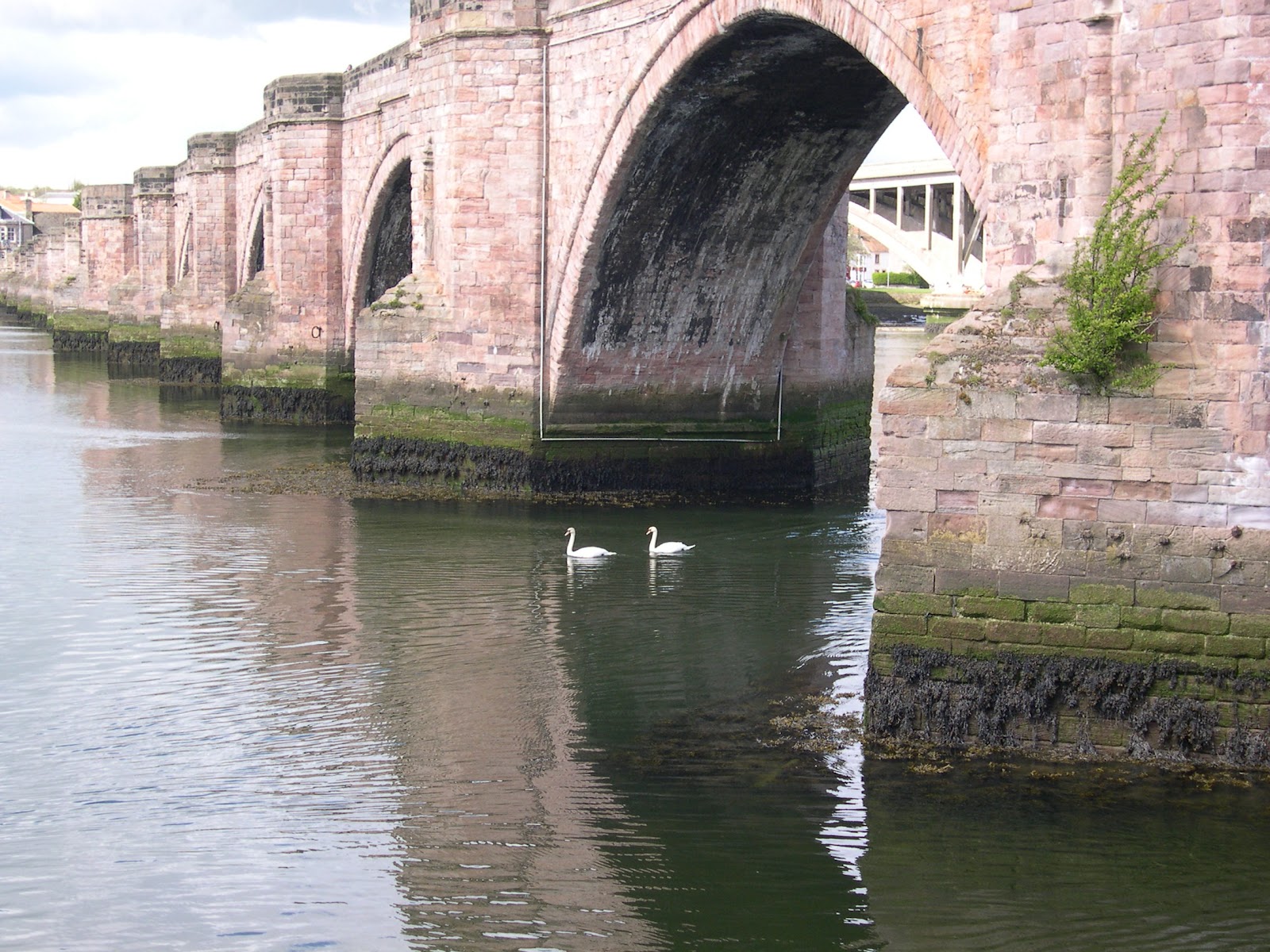
The story of the Anglo-Scottish twins has received extensive media coverage this week, and I've decided to join in. To read the full story, look at www.berwick-advertiser.co.uk. I can't show you any directly relevant photos without breaching copyright, so here are a couple of pretty pictures of bridges instead. One of them shows 'twin'  swans, geddit? Oh well, please yourselves.

The parents of these twins live in Wooler, a small town about fifteen miles south-west of Berwick. Their mother went into labour early on 1st July and gave birth to the first twin at home. An ambulance then took her to the nearest hospital, the Borders General, just outside the Scottish town of Melrose, where the other twin was born. Result: an English son and a Scottish daughter. Their father has joked about buying them English and Scottish football shirts respectively.

The only unusual thing about this story is that the unexpectedness of their arrival caused one of the babies to be born at home. Residents of the far north of England routinely receive treatment at Borders General hospital as well as Wansbeck hospital in mid-Northumberland. If you suffer a medical emergency and need to be rushed to hospital, the one you end up in will depend not only on the nature of your problem but on where exactly you live, where the ambulance has come from and which place you can be got to quickest in the prevailing road and weather conditions. During the heavy snow a couple of years ago one unfortunate woman in labour had to be air-lifted out of gridlocked traffic. And of course when a resident or visitor on Holy Island has a heart attack during the highest six hours of the tide, which seems to be a not infrequent occurrence, they can only be reached by air or boat. The air ambulance normally flies to a Newcastle hospital where there are helicopter landing facilities. On the other hand, if you collapse in Cornhill then a quick cross-border dash by road to Melrose will probably be the best option.

The future of health services in the event of Scottish independence becoming a reality is the greatest concern that residents of the English Borders have about the SNP referendum proposals. I hope that whatever happens we will never see a situation where any hospital would refuse to admit a woman in premature labour, no matter what her nationality might be. But it may very well be the case that an independent Scotland would not be prepared to pay for residents of England to receive routine health care in its hospitals. If that were so then people in Berwick, Wooler and the surrounding villages will face longer travelling times to hospital, a longer wait for emergency ambulances which are coming from further away and possibly even having to change their GP, because several GP practices have cross-border catchment areas. So far the SNP have said nothing beyond vague reassurances on this subject, and nobody believes that Alex Salmond has ever thought it through.

I once had a frustrating experience trying to get an SPCA inspector to come and rescue an injured bird in Berwick. The English branch based in Newcastle said that Berwick was too far to travel and the Scottish organisation said that they do not work over the border at all. Will we ever see the day when a phone call seeking help for an injured human produces the same response?

Thursday, 5 July 2012

Larn Yersel' Geordie


A few weeks ago I promised that I would write more about the accents and dialects of the Debatable LandFor the title of this post I've borrowed the name of a well known comic publication from the 1970s which played on the popular 'Teach Yourself' series and purported to be a serious instruction guide to the Geordie language. The name Geordie only applies to residents of Tyneside, the southern limit of the range of my blog, but that gives me an excuse to show you some nice photos of Newcastle Civic Centre. The sculpture on the left represents the Spirit of the River Tyne. When the building was formally opened by King Olaf of Norway in 1972 this sculpture had water flowing continuously over it, but all that's left now is the rust marks. Not a bad symbol of cuts in local government funding.
What 'Larn Yersel' Geordie' did only humorously is now being done all too seriously. Local dialects are being described as languages and treated as if they were quite unrelated to the dialect down the road. The term 'Geordie language' can now be used with a straight face. There is a Northumbrian Language Society  run mostly by people too middle-class to speak that way spontaneously, or indeed to wish to be associated with Geordies, who hold 'gatherings' to celebrate 'the tongue' and publish small dictionaries. Once you get north of the border the 'Scots language' is described as Lallans, which is not in any sense, you understand, a dialect of English, but a distinctive Scottish language, just as much a real language as the Gaelic of the Highlands. Meanwhile here in Berwick the natives insist that they speak 'a unique dialect' and there is a booklet with that title in the tourist gift shops.


 Am I the only person who thinks all this is nonsense? To those of us who grew up in Northumberland and spent our formative years travelling regularly around the area between Newcastle and Edinburgh, it was obvious that the dialect of Tyneside changed by gradual and almost imperceptible degrees into the dialect of Southern Scotland. The strong throaty sound of the Northumbrian R changed into the Scottish R, sounded further forward in the mouth and more trilled. But these days only elderly men in Northumberland still retain that sound in their speech and an abrupt change in the pronounciation of the letter R now marks the border. (See post of 31st May for more details.) In terms of vocabulary though many words not found in Standard English are still used throughout this whole region on both sides of the border. To take a few common examples: 'bairn' for 'child', 'sneck' for 'doorlatch',  'gowk' for 'cuckoo' or, figuratively, somebody who's being daft. But the pressure is on to assert a distinctive 'culture' and to leverage that to get funding from the bewildering array of arts and heritage bodies, quangos who have been left to fill the gap created by the undermining of local government funding over the last thirty years, of which the rusty Spirit of the Tyne is such a useful symbol.


One irony here is that the University of Newcastle used to have a well regarded Department of Scandinavian Studies, but closed it down, due to the same public sector funding crisis, which would no doubt be a sad disappointment to King Olaf. The dialects of Northern England and Southern Scotland are closely related to the Scandinavian languages, and if only this department had still been in existence the university could have cashed in on the current popularity of the Swedish and Danish drama serials shown on the BBC4 television channel, which are wildly fashionable among the chattering classes. The first time I realised that a word very similar to 'bairn' is the Standard Swedish for 'child', I nearly cried with happiness. When Geordies say it, the metropolitan elite sneer. When Wallander says it, they swoon. There is no better illustration of what linguistics experts keep telling us: the difference between a dialect and a language is purely political. 


Thursday, 28 June 2012

Spittal

Last week I mentioned Spittal and it occurred to me afterwards that most of my readers will never have heard of Spittal, so I thought that this week I would write a bit more about the place. The beach on the southern side of the Tweed estuary belongs to the village of Spittal while the beach on the north belongs to Berwick (as I described last week, any piece of litter chucked into the Tweed anywhere along its length eventually ends up on one or the other of them).  Spittal and Tweedmouth, the village slightly further to the west on the south bank of the estuary, have an uneasy relationship with the town of Berwick which dates back to the days when the river was the English-Scottish border. The south bank has never been in Scotland; Spittal and Tweedmouth used in fact to belong to the Bishops of Durham. Now that Berwick is in Northumberland they have been incorporated within the borough of Berwick, but they preserve a distinct identity and a reluctance to 'cross the bridge' is often heard on both sides of the river.


Spittal beach is one of the most attractive and most suitable for having fun on that I've ever seen in Britain, and accordingly it developed a reputation as a seaside resort. A very small seaside resort, a kind of bonsai version of Scarborough. The oldest inhabitants remember the annual excitement of the Kelso Trip, when hordes of children from the Scottish town of that name would descend on Spittal for their one day at the seaside, travelling by train to Tweedmouth station (long since closed down) and then walking the mile or so to the beach. Above is a photo of the 1930 shelter on the promenade, such a cute example of the period when seaside holidays and art deco flourished together that it makes me smile every time I see it. 


The picture on the right was taken on Boxing Day last year during the annual frolic of plunging into the sea for an icy dip to wash away that Christmas sluggishness. 2011 wasn't so bad, but in 2010 the participants had to run through the snow covering the sand even to get to the water. Nobody seems to have dropped dead from the shock to the system, but I noticed that the inshore lifeboat and a couple of its crew, who have some paramedic training, were standing by just in case.


If the weather had been better I could have brought you some photos of the Spittal Gala, which was held last week.The Kelso Trip used to be arranged to coincide with this. Every town in the Borders has some version of an annual gala or festival and the traditions go back a long time. Unfortunately the rain has been so unrelenting this year that the photographer from the local paper just had time to snap the contestants in the children's fancy dress contest before everyone was obliged to run for shelter from a torrential downpour and all of the other events were comprehensively washed out.


Of course Spittal was a centre of the fishing industry long before it was a holiday resort, but sadly the company that processed salmon there has now closed down. All that is left is this building in Sandstell Road, a fishing shiel dating back to at least 1735. A shiel is the name given to a small building used by fishermen to store their gear and to shelter and sleep while they wait for the salmon to arrive in the nets. They were once common along the Tweed but this is the only one to survive in its original form. An interesting feature of it is that the gable ends protrude higher than the present roof because it was originally thatched. It was finally abandoned less than thirty years ago and still contains some newspapers, mugs and odd items of clothing left behind by the last men to use it. A local group is working hard to gain the funds and recognition necessary to convert it into an information centre where visitors could learn more about the history of the fishing industry. More power to their elbow. Buildings like this which preserve the lives of ordinary working people must not be forever pushed to the bottom of the heritage conservation list in favour of yet another aristocratic mansion.


Friday, 22 June 2012

Nice Weather for Ducks

'Nice weather for ducks' was a common expression in my youth, but I haven't heard it for a while. It seems to be the only thing to say about the weather we're having just now. It's been wet. It's been very wet. It's been so wet that yesterday I had to put my jacket in the tumble-dryer as soon as I got home. Once the idea of ducks had come into my mind it seemed like a good opportunity to tell the story of this little chap.

I realise that a picture of a plastic duck doesn't quite fulfil my promise of 'a nice photo with every post', so here's one of a real bird that also copes well with the rain. There is almost always a heron to be seen around the Tweed estuary, standing motionless, staring down into the water, waiting for a fish, and if anything they are out more often in the rain. It's probably easier to see the fish when the sky is so grey. To learn more about the living birds of the area, look at the Farne Islands blog (on the list in my profile). It's always full of lovely photos and inspiring stories of the wildlife of the islands, but over the last few days even the Farnes writer seems to have run out of things to say except 'it's still raining'.

Anyway, back to the plastic duck. I found it on the beach a few weeks ago and got tremendously excited because I'd seen stories in the press about a flotilla of plastic ducks lost overboard from a container ship which was being tracked as a way of monitoring the circulation patterns of marine litter. I rushed back home and searched online for a description of them. Alas, this one didn't quite fit. Disappointed but still full of zeal to help with the fight against the junk which is polluting our oceans, a subject about which I feel very strongly, I read more about the work of Curtis Ebbemeyer, the American researcher behind the duck monitoring project. I then got excited all over again when I learned that a lost consignment of Nike trainers was also being tracked. Wow, I found a brand new looking trainer on the beach not long ago!  I got so carried away that I emailed the project to ask if I could help. They were polite but seemed to feel that my outpost on the North Sea was unlikely to receive any of the items they were monitoring.

I was forced to the conclusion that the trainer was much more likely to have just been dropped by a visitor, though I still don't quite understand why it wasn't on his foot, and why it looked so clean. I've found plenty of other unexpected items on the beaches around the Tweed estuary.  A model Shrek. A nearly new palette of eye make-up and a full can of body glitter spray. A whole vacuum cleaner. Less surprisingly, an awful lot of odd gloves and balls of every size and description left behind by dogs who got tired of retrieving them. Most of all though the beaches of Berwick and Spittal are disappearing beneath countless tonnes of plastic drinks bottles. Every bottle thrown into the Tweed upstream ends up on these beaches eventually. Every few months Spittal has an organised litter collection on the beach, but that's nothing like enough to keep up with the problem. I sometimes imagine that eventually the estuary will be so silted up with litter that it will be possible to walk across it without using any of the bridges. I once read that this was the reason for the disappearance of many small rivers that used to run through cities, such as the Fleet in London - they just had so much rubbish chucked in them that the water stopped flowing.

So how did the yellow bathtime playmate end up on the beach?  The answer hit me over the Jubilee weekend when I saw an item in the local paper about a duck race being held as part of the festivities. The photo showed dozens of plastic ducks just like this one being thrown into the river for a light-hearted wager on which one would pass the finishing point of the race first. Far from coming all the way from a lost shipment in the Pacific, my duck was almost certainly an escapee from a previous local race. Oh well.

Thursday, 14 June 2012

The Olympic Torch

The Olympic Torch arrived in Berwick today. Here it is. Look, you can actually see the flame. It spent the day making the journey through the heart of the Debatable Land from Edinburgh to Alnwick, according to a schedule worked out to the minute by the people whose rather strange job it is to organise these things. The torch was to arrive in Berwick at precisely 16.33 and leave at 17.10. Everyone wanted to get the dramatic photo of the Torch crossing the Tweed Bridge, and accordingly the crowds on the bridge were so dense that the chances of anyone succeeding were slim. I therefore decided to take up my position at the top of Castlegate where the backdrop is less impressive but the crowds were thinner.

The amount of fuss that has been made in anticipation of this blink-and-you've-missed-it event is extraordinary. Funds have been produced from thin air to paint all the bollards on the bridge, to make sure they look their shiniest in all that media coverage of the Torch 'crossing the border', and to place tubs of flowers at strategic locations. No fewer than five bands were playing at various points along the thirty-seven minute route and hundreds of people appear to have been prepared not only to turn out to cheer but to pay £2 for a Union flag to wave at the same time. The merchants of flags, balloons and whistles who were working the crowds hard all afternoon made me think, rather incongruously, of the souvenir sellers who reportedly made a good living out of the crowds at public executions a few hundred years ago.

The procession surrounding the torch was one of the most bizarre public spectacles I've ever seen. It began with a big yellow bus whose destination board said 'London 2012' and continued with a big red bus representing Coca-Cola and a big blue bus representing Samsung, with promo girls on the open decks shouting rousing slogans to the crowd at a level of amplification that drowned out the local bands. A more modest car bearing the logo of the third sponsor, Lloyds TSB, brought up the rear. There was then a very long gap, a good five minutes, before the excited Torch bearer herself appeared, smiling broadly and generally looking thrilled to be there.

The organisational abilities of London 2012 have not extended to arranging for all Torch bearers to run in their own home town. Only one of the seven bearers in Berwick lives in the town, but several other Berwickers are running in other towns. One of them was originally told to travel several hundred miles to the north of Scotland to do his stint, until a last minute change was agreed. Presumably this is because distances so far from London appear compressed to those sitting in Canary Wharf.  'It's all The North, isn't it? It's not like we're asking people to travel from Islington to Lewisham, that really would be unreasonable.'

Interspersed throughout the procession were numerous cars and motorcycles bearing members of the Metropolitan Police. Not the local Berwick constabulary, but the Met, which is the London police force.  They were behaving in a manner most unlike normal police demeanour, waving and smiling at the crowds, leaning over to shake hands with bystanders. The Met is apparently on some sort of nationwide charm offensive. The message on one of the cars informed us that we can now follow the Metropolitan Police on Twitter. (Imagine it. '3.07 a.m. I'm chasing a villain round the estate. Oh dear, he seems to have got away while I was typing this tweet.')

I've had a jaundiced view of the Olympic Torch ritual since I learned that it first appeared at the Berlin 1936 Olympics. To be fair, the flaming torch is a common motif in the Art Deco style of the period, and did not as far as I am aware have any special National Socialist significance. But it still makes the whole business hard to warm to. Invented by Nazis, sponsored by Coca-Cola, organised by Londoners who don't know where the Scottish border is - yet somehow still a good enough excuse for an enjoyable afternoon out. The Berwick Advertiser reports that one local lady has been telling her doctors for years that she just wants to stay alive long enough to see the Olympics, and is now excited beyond words to be celebrating her 90th birthday on the day the Torch passes through her home town. Good for her.


Thursday, 7 June 2012

The Diamond Jubilee: the final flourish of the Union Jack?

Berwick upon Tweed is covered in a rash of red, white and blue bunting for the Queen's Diamond Jubilee. The shops have been having a competition for the best window display with a Jubilee theme. On the left, the Barrels pub, known for real ale and good music, flies the flag. But for how much longer will the said flag be flown anywhere?

The Union flag (strictly speaking the name Union Jack only applies to the nautical version) was created by combining the flags of England, Scotland and Ireland. The 'blue' bit of the red, white and blue comes from Scotland. There is very little understanding of this fact among the English general public, and howls of outrage can be anticipated if and when an independent Scotland demands that England remove the Scottish element from its flag. Personally I think that the real grievance lies with the Welsh, whose flag has never been incorporated into the Union Jack. That big red dragon just didn't fit in with all the crosses. Since Wales now has its own movement for independence, there's not much point in trying to add it at this late stage. The red and white cross of England is a familiar sight at sporting events and I think that most of the English could get used to having it as their only flag without too much difficulty. Northern Ireland is another matter - what the residents of the Shankill Road would tie to their lamp-posts after the abolition of the Union flag boggles the imagination, but that's a question outside the scope of this blog.

Watching the television coverage of the Jubilee pop concert held outside Buckingham Palace, I was surprised when in the finale, as the red, white and blue lights played over the facade of the Palace and the red, white and blue fireworks exploded above its roof, the band segued directly from God Save the Queen into Land of Hope and Glory. This will probably have upset a fair few of the non-English citizens of the UK. The anthem Land of Hope and Glory is purely English. It is played at sporting events where England is competing independently of the other nations of the UK. There seems to be no justification for playing it at an event which was above all intended to bring all the Queen's subjects together in harmony, and the decision to do so was a piece of populism ('they love singing it at the rugby, don't they?') which showed no awareness of Scottish or Welsh sensitivities.
Alex Salmond has been careful not to pick an unnecessary fight by calling for Scotland to become a republic as well as independent.  The decision on whether an independent Scotland would wish to sever links with the monarchy is one for another referendum at a much later date, says the official SNP position, and in the meantime Scotland would become simply another member of the Commonwealth, retaining the Queen as head of state. Indeed the Queen's position as monarch of Scotland is arguably separate from her occupancy of the English throne. The two monarchies were by accident of inheritance united in the same person, that of James 1 of England and VI of Scotland, in 1603, and have continued to be represented by the same person ever since, but the claim to the two thrones, according to some constitutional lawyers, remains distinct. In 1953 there was a strong lobby demanding that the Queen have a second coronation in Edinburgh, in recognition of this fact, but that was dismissed by the English Establishment types running the show. King Charles III (or Charles IV for those with Jacobite sympathies) on the other hand is very likely to be obliged to make the journey to Holyrood for a second ceremony.